




NEWS
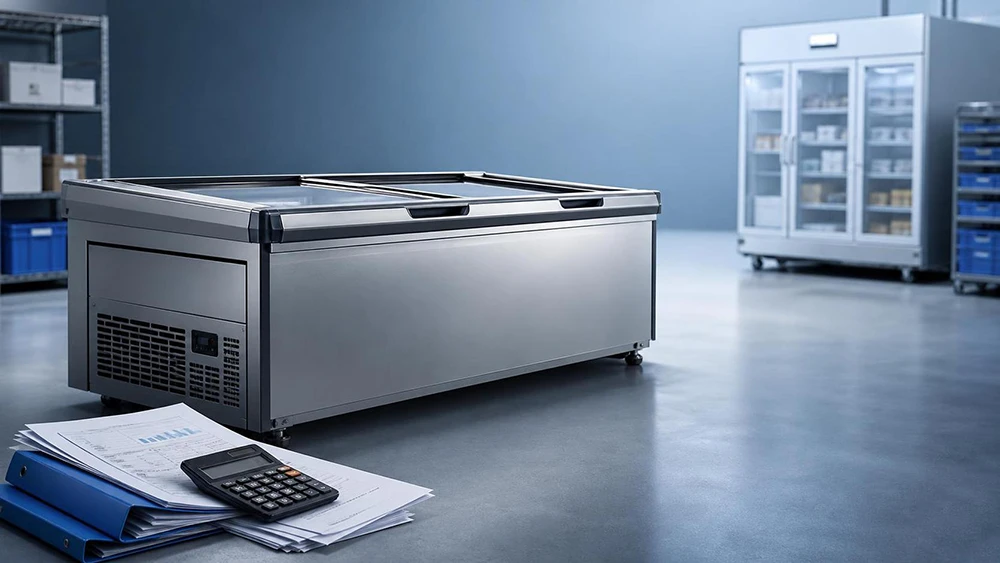
Before approving a commercial deep freezer purchase, finance teams should calculate the total energy cost over the unit’s working life, not just compare quotations. A lower upfront price can quickly lose its advantage if the freezer runs inefficiently, cycles too often, or struggles under real operating conditions.
For buyers responsible for budget control, the key question is simple: how much will this equipment actually cost the business per year and over its full service life? The right answer requires looking at power consumption, electricity tariffs, daily operating patterns, maintenance risk, and the freezer’s fit with the application.
For most financial approvers, the strongest buying decision does not come from the cheapest unit. It comes from the model that balances acquisition cost, stable temperature performance, predictable energy use, and a lower risk of waste, downtime, or premature replacement.
What Financial Decision-Makers Are Really Trying to Confirm
When someone searches for commercial deep freezer energy costs, they usually are not looking for a generic definition of wattage. They want a practical way to compare options, forecast operating expense, and avoid approving equipment that becomes expensive after installation.
That is especially true for catering groups, supermarkets, bakeries, convenience stores, and seafood or meat businesses where refrigeration runs continuously. In these settings, even a moderate efficiency gap can create meaningful cost differences when multiplied across long operating hours and multiple locations.
Financial approvers also want clarity on risk. They need to know whether a proposed commercial deep freezer supports margin protection, or whether hidden operating costs will erode the expected return on investment after purchase.
Why Purchase Price Alone Leads to Weak Buying Decisions
A commercial deep freezer is a long-life operating asset, not a one-time supply purchase. If evaluation stops at the invoice amount, buyers can overlook the larger cost created by years of electricity consumption and the secondary costs tied to unstable performance.
In many businesses, the freezer’s service life can easily extend for years. Over that period, energy spend may become a major share of the total ownership cost, especially in hot climates, high-traffic kitchens, or stores with frequent door openings.
A lower-cost model may also use thinner insulation, a lower-efficiency compressor, or less effective heat exchange design. Those tradeoffs are not always obvious in a quotation, but they can directly raise monthly utility bills and increase stress on the refrigeration system.
For finance teams, this changes the evaluation standard. The right question is not, “Which freezer costs less today?” but, “Which freezer gives the business the lowest acceptable cost per year while meeting operational needs?”
How to Calculate the Real Energy Cost Before Ordering
The most useful approach is to estimate annual electricity expense using rated or tested energy consumption data, then convert that number into service-life cost. This gives a clearer financial basis than relying on broad claims such as energy-saving or heavy-duty.
Start with the freezer’s energy use in kilowatt-hours. Some suppliers provide daily or annual consumption figures, while others list power rating only. If only wattage is available, buyers should ask for realistic operating consumption, because compressors cycle on and off rather than draw full load every minute.
A practical annual energy formula is straightforward: annual kilowatt-hours multiplied by local electricity rate equals yearly operating cost. If the unit uses 12 kWh per day, annual consumption is about 4,380 kWh. At an electricity rate of $0.15 per kWh, the yearly cost is about $657.
Then extend that estimate across the expected service life. Over seven years, that same unit would consume roughly $4,599 in electricity, assuming a stable tariff. Once buyers compare several models this way, apparent price advantages often look very different.
Finance teams should also run a sensitivity check. Electricity rates may rise, ambient temperatures may be higher than test conditions, and product loading may increase over time. A freezer that appears close in cost on paper can become much more expensive under real use.
Which Technical Factors Matter Most for Energy Spending
Not every specification has equal financial importance. For cost forecasting, a few technical factors have a direct and recurring impact on operating expense, and these deserve closer attention during supplier comparison.
Insulation quality is one of the first. Better insulation reduces heat gain, which means the compressor works less to maintain set temperature. Over years of operation, strong insulation can materially reduce electricity use while also supporting more stable storage conditions.
Compressor efficiency is another major factor. A well-matched, reliable compressor affects both power draw and long-term durability. Financial buyers do not need to become engineers, but they should ask whether the compressor is selected for continuous commercial use and whether performance data is available.
Cabinet design also matters. Lid sealing quality, hinge performance, interior layout, and thermal bridge control all influence how much cold air is retained during normal operation. Poor sealing may look minor at delivery but become a permanent cost driver later.
Condenser and evaporator efficiency influence how effectively the refrigeration system moves heat. Better system design can shorten run time, improve recovery after door opening, and lower unnecessary energy consumption in busy environments.
Why Usage Conditions Can Change the Numbers Significantly
Published specifications are useful, but they do not tell the whole story. Real energy cost depends heavily on how and where the commercial deep freezer will actually be used after installation.
Ambient temperature is one of the biggest variables. A freezer placed in a hot kitchen, near cooking equipment, or in a poorly ventilated back-of-house area will generally consume more electricity than the same unit in a cooler, controlled environment.
Opening frequency matters too. In supermarkets, convenience stores, and busy foodservice operations, repeated access increases warm air infiltration. The system must then work harder to pull temperatures back down, increasing power consumption through the day.
Product loading patterns also affect cost. Freezers loaded with warm product require more cooling effort than units storing already frozen inventory. Businesses with frequent replenishment cycles should factor that into their operating assumptions before making approvals.
Defrost behavior, cleaning standards, and airflow clearance around the unit also shape performance. Even an efficient model can consume more energy if installed in a way that restricts heat rejection or allows frost buildup to reduce system efficiency.
How to Compare Two Freezer Quotes Like an Investor, Not Just a Buyer
When reviewing proposals, finance teams should build a simple comparison table that combines purchase price, annual energy cost, warranty scope, expected service life, and likely maintenance exposure. This turns a product comparison into an investment decision.
For example, suppose Model A costs $1,200 and Model B costs $1,500. If Model A uses $780 of electricity per year and Model B uses $610, the annual savings of Model B is $170. Over seven years, that difference becomes $1,190, which more than offsets the higher purchase price.
This kind of analysis is especially useful when procurement teams receive mixed quotations from different factories, traders, or OEM suppliers. A lower unit price can look attractive during tender review, but the lifetime cost view often reveals the stronger option.
It is also worth assigning value to operational stability. If one freezer offers better temperature consistency, lower spoilage risk, or stronger parts quality, that can reduce indirect costs that never appear in the original invoice but still affect profit.
Questions Finance Teams Should Ask Suppliers Before Approval
Good supplier conversations reduce uncertainty. Instead of accepting broad marketing claims, buyers should ask for data that supports cost forecasting and asset evaluation.
Useful questions include: What is the tested daily or annual energy consumption? Under what ambient conditions was that figure measured? What compressor brand and specification are used? What insulation thickness and material are included? What is the expected service life under commercial use?
It also helps to ask about spare parts availability, warranty response, and OEM or ODM configuration options. In some cases, a manufacturer can adjust cabinet size, insulation, or component selection to better match operating conditions and control long-term energy spend.
For importers, distributors, and multi-site operators, supplier capability matters beyond the product itself. A source factory with integrated R&D, sheet metal processing, complete machine production, and quality inspection can often provide more consistent technical documentation and product control.
Where Broader Business Value Enters the Decision
Energy cost is a central calculation, but it is not the only one. For financial approvers, the right commercial deep freezer should also support broader business objectives such as standardization, operating predictability, and lower lifecycle risk.
In chain operations, consistent freezer specifications can simplify maintenance planning and reduce spare parts complexity. In export or project procurement, reliable OEM support can make it easier to align equipment with local market needs and site constraints.
There is also a brand and compliance dimension. Stable refrigeration performance supports food safety, inventory protection, and operational credibility. A freezer that underperforms can create losses that far exceed the electricity bill, especially for seafood, meat, dairy, and frozen prepared foods.
For businesses planning long-term growth, choosing a professional manufacturing partner can improve purchasing confidence. Companies such as Baisite, with focused experience in commercial freezer and chiller production for global foodservice and retail applications, can be evaluated not only on price but on production depth, customization ability, and consistency.
A Practical Approval Framework Before You Place the Order
Before giving final approval, finance teams should verify five points. First, confirm realistic annual energy consumption. Second, calculate service-life electricity cost using local tariffs. Third, compare that number against the purchase price difference between models.
Fourth, review whether the unit’s technical design matches the actual use environment, including ambient heat, loading frequency, and product type. Fifth, assess supplier reliability, warranty support, and the likelihood of stable long-term performance.
This framework is simple, but it prevents a common mistake: approving refrigeration equipment as if it were a short-term purchase. In reality, the financial impact continues every day the freezer is running.
Conclusion
The real cost of a commercial deep freezer is shaped far more by years of energy use and operating performance than by the purchase price alone. For financial decision-makers, the smartest evaluation combines electricity cost forecasting, technical review, and supplier assessment.
When buyers calculate annual consumption, test assumptions against real usage conditions, and compare total ownership cost instead of headline price, they make stronger approvals. That approach protects budgets, improves operational efficiency, and leads to refrigeration investments that stay financially sound over time.
 Food Safety Points to Check When Choosing a Refrigerated Worktable for Prep Areas
- Commercial Deep Freezer Energy Costs: What Buyers Should Calculate Before Ordering
- What Is a Commercial Drink Fridge and Where Is It Most Useful in Foodservice Operations?
- Small Beer Showcase Buying Guide for Cafes, Kiosks, and Limited-Space Beverage Corners
- What Makes an Ice Cream Glass Display Freezer Suitable for High-Traffic Retail Stores?