




Food Safety Points to Check When Choosing a Refrigerated Worktable for Prep Areas
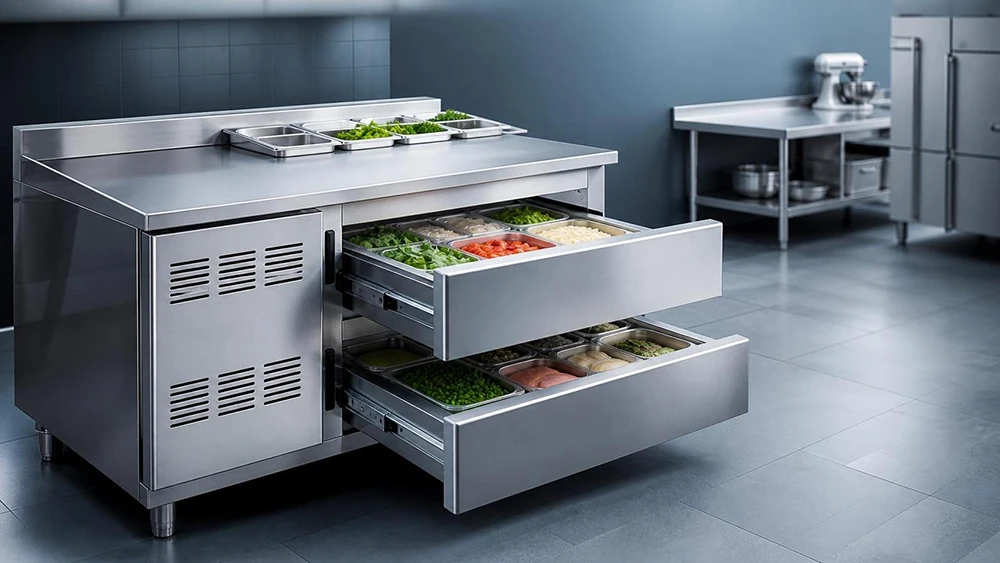
In many prep areas, the problem does not start with a major equipment failure. It usually starts with small, repeated issues: ingredients sitting too long at unsafe temperatures during rush periods, condensation forming around food pans, corners that are hard to sanitize, or staff using a work surface that looks sturdy but is difficult to keep hygienic. When that happens, a Refrigerated Worktable or Refrigerated Counter stops being a simple piece of kitchen furniture and becomes a food safety risk.
For quality control teams, kitchen planners, and purchasing staff, choosing the right unit means checking more than capacity and price. The better approach is to evaluate how the table supports temperature control, cleaning routines, ingredient separation, and day-to-day prep discipline. If you are comparing models for a central kitchen, bakery, deli, supermarket backroom, or restaurant prep line, the points below help narrow the choice using practical food safety logic rather than guesswork.
Why a Refrigerated Worktable Can Become a Food Safety Weak Point
A prep area is one of the busiest parts of any food operation. Raw materials are moved in and out, tools are shared, surfaces are wiped down repeatedly, and staff often open refrigerated sections many times within a short period. Under these conditions, even a well-rated cold unit can create problems if its design does not match the workflow.
Common trouble signs include uneven cabinet temperature, door seals that trap residue, top surfaces that are difficult to sanitize quickly between tasks, and layouts that force raw and ready-to-eat ingredients too close together. None of these issues are dramatic on their own, but together they increase the chance of contamination, product waste, and failed internal checks.
This is why a Refrigerated Counter used in a prep zone should be judged as part of the hygiene process, not only as refrigeration equipment. The unit has to support safe handling before, during, and after service.
Start With the Most Basic Question: What Kind of Prep Happens on the Table?
One common mistake is choosing a Refrigerated Worktable based only on external size or storage volume. That usually leads to mismatches between the unit and the actual prep task. Before comparing materials, compressors, or shelf layouts, it helps to define what is happening on the worktop.
For example, the food safety priorities are different if the table is used for:
- Vegetable washing and portioning after receiving
- Sandwich or salad assembly with frequent ingredient access
- Raw meat or seafood trimming
- Bakery filling, topping, or dough staging
- Temporary cold holding before line service
In raw-protein prep areas, resistance to contamination and easy cleaning of joints, handles, and underside edges matter more than decorative appearance. In fast assembly lines, temperature recovery after repeated door opening becomes more important. In bakery use, stable cooling and clean stainless work surfaces may be enough, while splash resistance and ingredient segregation may matter less than in meat prep.
In short, food safety starts with matching the equipment to the process. A good buying checklist always begins with the prep scenario.
The Material Check: Stainless Steel Quality Is Only the First Layer
Many buyers know to ask for stainless steel, but that alone is not a complete hygiene standard. The better question is how the material is used across the full structure of the Refrigerated Counter.
When reviewing a unit, look at these points carefully:
- Work surface finish: The top should be smooth, easy to wipe, and free from rough treatment marks that can hold residue.
- Welded and joined areas: Sharp seams, exposed gaps, or uneven edge finishing make sanitation slower and less reliable.
- Internal liner and corners: Rounded internal corners are generally easier to clean than tight square corners where liquids and particles collect.
- Underside structure: Hidden ledges beneath the worktop often collect flour, moisture, grease, or protein residue if the design is too complex.
- Door and drawer contact points: Handles, gaskets, and track areas should tolerate repeated cleaning without becoming residue traps.
A surface can look acceptable in a showroom and still be difficult in daily sanitation. It is worth checking whether staff can wipe all food-contact and near-food-contact areas quickly during a real shift, not only during deep cleaning.
Temperature Stability Matters More Than the Lowest Display Number
Another frequent misunderstanding is assuming that colder always means safer. In practice, food safety depends more on stable, recoverable, usable refrigeration than on an aggressively low empty-cabinet reading.
A Refrigerated Worktable in a prep area is opened often, loaded with products at different temperatures, and exposed to ambient heat from nearby cooking or washing stations. Because of that, the key points to check are:
- How evenly cold air is distributed inside the cabinet
- Whether the unit recovers temperature after door or drawer opening
- Whether the design supports practical loading without blocking airflow
- Whether controls allow staff to monitor and manage the set range clearly
- Whether insulation and sealing reduce unnecessary temperature fluctuation
If ingredients near the front warm up faster than those at the back, or if overloading reduces circulation, the unit may still be running while food safety control becomes inconsistent. That is especially relevant for high-turnover prep stations where speed can tempt staff to leave compartments partly open or rest products on the counter too long.
When evaluating a Refrigerated Counter, do not focus only on the advertised cooling function. Ask how the structure supports real operating conditions in the prep area.
Easy Cleaning Is Not a Convenience Feature; It Is a Safety Feature
In many kitchens, cleaning compliance fails where cleaning takes too long. Staff are more likely to skip awkward corners, fixed obstructions, deep tracks, or heavy removable parts that interrupt workflow. That is why cleanability should be treated as a buying standard rather than an afterthought.
Useful details to check include removable shelving, accessible drain paths if present, smooth drawer tracks, durable gaskets that can be cleaned properly, and enough clearance around the base for floor sanitation. If a unit stands flush in a tight line without planning access space, food debris and moisture can build up around it even if the cabinet itself is easy to clean.
It also helps to think about cleaning frequency by zone. A table used for raw food prep may need more intensive sanitation routines than a unit used only for packed ingredients. The design should make the stricter routine realistic.
Check Whether the Layout Helps Prevent Cross-Contamination
Many food safety problems come from workflow overlap rather than temperature failure. A Refrigerated Worktable may technically cool well but still create risk if it encourages poor separation of ingredients, tools, or prep stages.
When comparing models, review how the cabinet and worktop support separation in practice:
- Can raw and ready-to-eat items be stored in clearly separated zones?
- Are drawers or doors organized in a way that reduces unnecessary searching and repeated handling?
- Is the top large enough for the actual task without forcing containers to crowd together?
- Can the unit be positioned so it does not sit between incompatible prep activities?
- Does the workflow reduce hand contact between storage, prep, and transfer steps?
These questions are especially important in mixed-use kitchens where available space is limited. If one table is expected to support too many tasks, the hygiene risk usually shows up later in rushed service periods.
How to Review a Refrigerated Counter Before Purchase
If you are choosing between several units, a simple review sequence helps keep the decision objective. This is often more useful than comparing catalog descriptions line by line.
- Map the prep task: Identify what foods will be handled, how long they stay on the station, and how often the cabinet will be opened.
- Check contact surfaces: Review top construction, internal corners, joints, handles, and drawer or door details for sanitation practicality.
- Assess temperature use conditions: Consider kitchen ambient heat, nearby equipment, loading habits, and opening frequency.
- Review organization options: Make sure shelves, pans, or drawers support ingredient separation rather than crowding.
- Think about cleaning access: Confirm staff can reach the interior, the underside, sealing areas, and surrounding floor space without excessive disassembly.
- Confirm maintenance logic: A unit that is difficult to inspect or service can drift into hygiene problems over time.
This process tends to expose weak points early. A model may look efficient on paper but fail once you test it against real prep flow and sanitation expectations.
When Source Manufacturing Details Actually Matter
For buyers responsible for repeated procurement, source manufacturing quality can affect consistency in ways that are easy to overlook at the quotation stage. That includes sheet metal accuracy, assembly quality, fit of doors or drawers, and whether the overall structure feels designed for long-term commercial cleaning rather than occasional use.
Baisite, based in Xingfu Town, Binzhou, Shandong Province, manufactures commercial refrigeration kitchen equipment with in-house capabilities covering research and development, sheet metal processing, machine production, quality inspection, export trade, and OEM and ODM customization. For purchasers who need a Refrigerated Worktable or Refrigerated Counter adapted to a specific prep environment, this kind of integrated production path can be relevant because it gives more room to align dimensions, internal layout, and working configuration with the intended hygiene workflow.
That does not replace on-site evaluation, but it can help when the standard off-the-shelf format does not fit the prep line or sanitation method you need to maintain.
Common Buying Mistakes That Create Food Safety Problems Later
Several purchasing mistakes show up repeatedly across prep environments.
- Choosing by external size alone: A compact footprint is useful, but not if it compromises cleaning access or ingredient separation.
- Ignoring workflow heat load: A unit placed near ovens, fryers, or dishwashing zones faces a very different operating condition than one in a cool prep room.
- Assuming all stainless units are equally hygienic: Finishing, seams, and internal geometry make a real difference.
- Overlooking repeated door opening: In line prep use, recovery behavior matters more than static showroom conditions.
- Buying a multi-use station for incompatible tasks: Combining raw and ready-to-eat prep around one station often creates avoidable risk.
Most of these mistakes come from treating refrigeration and food safety as separate decisions. In prep areas, they are directly linked.
Frequently Asked Questions
Is a Refrigerated Worktable always better than a standard upright refrigerator for prep areas?
Not always. A Refrigerated Worktable is useful when ingredients need to stay close to the prep surface and be accessed frequently during production. If the main need is bulk storage with limited opening, an upright unit may be more suitable. The safer choice depends on the workflow, not on equipment category alone.
What should I check first if food safety is my main concern?
Start with cleanability, temperature stability under real use, and ingredient separation. Those three factors usually have more impact on daily compliance than appearance or nominal capacity.
Are drawers safer than doors on a Refrigerated Counter?
Neither option is automatically safer. Drawers can help organization and reduce searching time, but they also need to be easy to remove and clean. Doors may provide simpler access for some layouts. The better choice is the one that supports clear zoning and practical sanitation in your operation.
How important is customization for food safety?
Customization matters when the standard unit creates workflow conflict, such as poor spacing, awkward pan layout, or limited separation of ingredients. It is useful when it solves a real hygiene or operational problem, not when it only changes appearance.
Should I evaluate the unit only by technical specifications?
No. Specifications are useful, but they do not show how staff will clean the unit, load it during peak periods, or maintain separation between products. Food safety performance depends on both equipment design and actual use conditions.
Conclusion
Choosing a Refrigerated Worktable for a prep area is really a decision about control. The right unit should help maintain hygienic surfaces, stable temperatures, organized storage, and a workflow that reduces contamination pressure during busy hours. If a model looks efficient but creates cleaning blind spots or ingredient overlap, it is likely to cause problems later.
A practical review starts with the prep task, then moves through material finish, internal design, temperature behavior, cleaning access, and separation logic. That approach makes it easier to choose a Refrigerated Counter that fits both operational needs and food safety expectations, especially in commercial kitchens where small design details quickly become daily compliance issues.