




NEWS
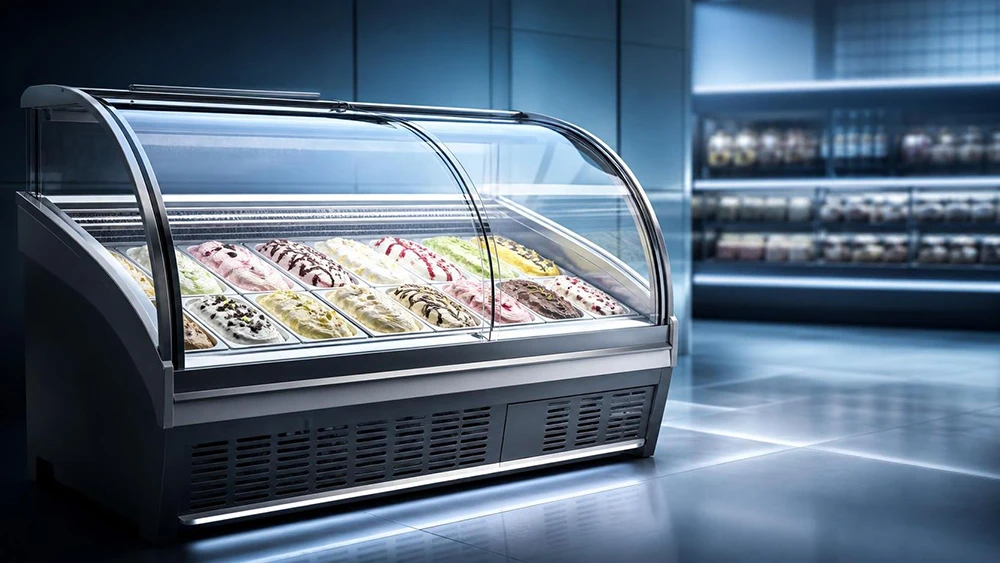
For a busy store, the right Ice cream glass display freezer has to keep product temperature stable while the cabinet is repeatedly accessed, viewed from every angle, and exposed to fluctuating room conditions. A unit may look attractive on the sales floor and still perform poorly once foot traffic increases. Suitability comes from the interaction of refrigeration capacity, air circulation design, cabinet construction, glass performance, defrost control, and the way the freezer fits the actual operating pattern.
The first point to judge is whether the refrigeration system can recover quickly after frequent lid or door opening. In a high-traffic setting, warm ambient air continuously enters the display zone. If the evaporator capacity is marginal, the product surface softens before the cabinet can pull the temperature back down. This is especially relevant for ice cream because the product is sensitive not only to obvious melting, but also to repeated micro-fluctuations that can affect texture, scoopability, and frost buildup on packaging. A freezer that performs well in a static showroom test may behave very differently beside a checkout aisle, under ceiling spotlights, or near an entrance.
That is why compressor selection matters beyond nameplate cooling output. A cabinet intended for heavy retail use generally needs a refrigeration circuit with enough reserve capacity for pull-down and recovery, rather than one sized only for steady-state holding. Condenser sizing also deserves attention. If the condenser is too small or becomes fouled easily, head pressure may rise during long daily operation, reducing efficiency and making temperature control less stable. In practical assessment, it helps to look at condenser accessibility for cleaning, fan layout, and whether the airflow path is likely to be blocked when the unit is placed close to walls or other fixtures.
Cabinet temperature behavior under real store conditions
A common mistake is to focus on the thermostat setting without examining temperature distribution across the display deck. In an ice cream glass display freezer, the critical issue is not just the air temperature at one probe location. Product at the front glass, corners, top baskets, and areas closest to the opening can face different heat loads. Uneven air circulation may create warm bands where certain tubs soften faster than others. For this reason, the internal duct arrangement, evaporator fan logic, and return-air path deserve more attention than cosmetic details.
If the unit uses forced-air circulation, the airflow should be strong enough to support uniformity without drying exposed surfaces excessively. If the cabinet relies more on static cooling, then basket arrangement, loading height, and frost management become even more important. Either design can work, but only when matched to the intended service model. A self-service environment with frequent opening places heavier demands on temperature recovery than a staffed counter where access is shorter and more controlled.
Ambient design conditions should also be checked carefully. A freezer rated for moderate room temperatures may struggle in stores with poor HVAC control, solar gain through front windows, or long operating hours with dense footfall. If the installation area is likely to experience higher ambient temperature or humidity, the margin built into the refrigeration system becomes more important than the nominal display volume.
Glass structure affects both merchandising and thermal load
The glass assembly is not only a visibility feature. In a high-traffic store, it directly affects heat ingress, condensation behavior, and cleaning workload. Straight or curved tempered glass is commonly used for durability and safety, but the real performance question is whether the glazing system limits condensation when indoor humidity rises. Once glass fogging becomes persistent, product visibility drops and the merchandising purpose of the cabinet is weakened.
Double-layer glass, heated glass in some configurations, and well-designed frame seals can improve viewing quality in humid conditions. However, these features should be evaluated with the overall energy and maintenance implications in mind. Heated glass may reduce condensation, but it adds electrical load and can increase the thermal burden on the refrigeration system if not balanced properly. Seal quality around sliding glass lids or top covers is equally important. Poorly fitted seals increase infiltration, which leads to frosting, longer compressor run time, and unstable temperatures in the upper product zone.
Frame material and edge finishing also matter in a store where customers repeatedly touch the cabinet. Aluminum alloy frames are common because they are light and corrosion resistant, while stainless steel trim may offer better rigidity and easier sanitation in harsher environments. The finish should tolerate cleaning chemicals without pitting or discoloration. Rough seal joints, exposed fasteners, and poorly finished corners tend to collect residue and become maintenance points over time.
Frequent opening changes the selection logic
High traffic puts mechanical stress on access components. Sliding glass lids, rear service doors, hinges, handles, rollers, and guide rails need to be judged as wear items, not just convenience features. A lid that drags slightly in a sample room may become a recurring problem after thousands of opening cycles. Misalignment can weaken sealing pressure, increase operator effort, and eventually damage the glass or frame.
Where customer self-service is expected, lid travel should be smooth and predictable, with enough resistance to avoid slamming. For rear service models, the working clearance behind the unit needs to be realistic. A well-built cabinet can still become inefficient if staff have to hold doors open longer because the opening angle is cramped or product access is awkward. In other words, physical ergonomics and refrigeration performance are linked in daily operation.
Basket design is often underestimated. Wire baskets with protective coating are typical, but spacing, depth, and load support determine whether products remain visible without blocking airflow. Overloaded baskets or improvised stacking above the intended fill line can interfere with circulation and lead to warm spots near the top. If the store carries mixed pack sizes, the internal layout should support that assortment without forcing unstable stacking.
Insulation and cabinet body quality are easier to verify than promises
The body of the freezer should be evaluated as a thermal enclosure. Polyurethane foam insulation is standard in many commercial cabinets, but foam density, injection quality, and continuity around corners influence real heat leakage. Thin spots in the insulation layer, voids near frame interfaces, or weak thermal breaks around glass supports can create hidden losses that only become visible later through excessive frosting or long compressor run times.
Outer shell material is not only a cosmetic choice. Powder-coated steel can be acceptable in many indoor retail environments, provided the coating quality and edge protection are good. Stainless steel is generally more tolerant of repeated cleaning and incidental impact, especially around service areas and lower kick zones. Interior liners should resist corrosion, absorb minimal odor, and allow straightforward wipe-down. Sharp folds or unfinished joints inside the product chamber tend to trap debris and complicate sanitation.
Sheet metal fabrication quality offers useful clues. Consistent panel gaps, clean bends, stable mounting points, and well-supported compressor compartments usually indicate better assembly control. Rattling panels, thin unsupported covers, or loosely fixed electrical boxes may not affect display appearance at first glance, but they often signal vibration, noise, or service issues later.
Defrost strategy can determine whether the display stays usable all day
In high-humidity traffic environments, frost accumulation is not a minor detail. Frost on the evaporator or around lid tracks can reduce airflow, impair sealing, and make access difficult. The freezer should have a defrost approach suited to frozen dessert holding rather than a generic program. Defrost cycles that are too aggressive may disturb product temperature. Cycles that are too weak may allow gradual ice buildup until the cabinet loses capacity.
Attention should be paid to where meltwater goes, how the drain route is protected from refreezing, and whether the drain area is easy to inspect. A poorly designed drain pan or hidden blockage path can create water overflow, ice around moving parts, or sanitation concerns. In a retail setting where the unit runs continuously, small drainage flaws tend to become operational problems quickly.
Electronic controls should also be assessed for practicality. A readable controller with stable sensing, alarm logic, and accessible setpoint adjustment is useful only if the sensor placement reflects product conditions reasonably well. If the probe sits in an overly protected area, the displayed temperature may look acceptable while the exposed upper layer runs warmer. Probe location, wiring protection, and control calibration matter more than the number of display functions.
Lighting should support sales without adding unnecessary heat
Lighting inside or around the canopy can improve product visibility, but it has to be considered as part of the thermal design. LED lighting is commonly preferred because it adds less heat than older lamp types and generally offers longer service life. Even so, poorly positioned light strips can create local warming near the front row of products or cause glare on curved glass, reducing visibility rather than improving it.
In a high-traffic store, glare becomes more noticeable because customers view the cabinet from multiple angles and under mixed ceiling lighting. The best arrangement usually combines adequate illumination with restrained brightness and shielding that avoids reflected hotspots on the glass. Serviceability is relevant here too. Replacing a failed light should not require dismantling major glass components or exposing insulation cavities.
Noise, vibration, and airflow discharge influence placement options
Freezer selection often focuses on internal performance while ignoring how the unit behaves in the surrounding retail environment. Compressor noise, fan vibration, and warm condenser air discharge can affect where the cabinet can actually be installed. A technically capable unit may still be unsuitable if its ventilation pattern overheats a narrow aisle or if its condenser intake is easily clogged by packaging dust and floor debris.
Self-contained models are easier to install, but they reject heat directly into the room. In crowded stores, that can increase the burden on air conditioning and indirectly worsen freezer performance. Remote systems can reduce local heat rejection if the site is configured for them, though piping layout, commissioning quality, and service access then become part of the evaluation. The correct choice depends on site conditions rather than a universal preference.
Transport and installation details affect later reliability
Damage during transport is a practical risk with glass display equipment. The cabinet should be assessed for packaging robustness, base frame strength, and lifting points that allow safe handling by forklift or pallet jack. Glass breakage is the obvious concern, but compressor mounting stress, bent lid tracks, and distorted sheet metal around the base can also happen if the unit is poorly protected. These issues may not be fully visible until the freezer is leveled and loaded.
Installation conditions should be reviewed before the unit arrives on site. Floor flatness matters because cabinet twist can affect lid alignment and sealing. Power supply stability, circuit capacity, and plug or terminal configuration need to match the equipment. Ventilation clearance around the condenser section should be based on actual site dimensions, not assumed from a brochure drawing. If the unit includes castors, their load rating and locking reliability should be checked against the filled operating weight, not only the empty cabinet mass.
Commissioning should include enough time for oil settling after transport if required by the system configuration, followed by verification under load rather than only an empty-cabinet run. An empty display can cool quickly and appear stable while behaving differently once product mass, frequent opening, and store ambient variation are introduced.
Maintenance access is part of performance
A freezer in a high-traffic retail setting is expected to run for long hours with limited downtime. Routine tasks such as condenser cleaning, gasket inspection, drain checking, and controller verification should be possible without major disassembly. If a service technician has to remove decorative panels, disconnect lighting, or work in cramped spaces just to reach common maintenance points, upkeep may be delayed and performance may decline gradually.
It is useful to look for practical details: removable grilles that can be reinstalled without distortion, clearly routed wiring harnesses, fan motors that can be replaced without disturbing the refrigeration circuit, and gaskets that are fitted consistently around the opening perimeter. These are small construction choices, but they strongly affect service time and the likelihood that maintenance is actually performed at the needed interval.
- Evaporator and condenser sections should be separated enough that dust from the condenser side does not contaminate the product chamber during cleaning.
- Sliding lid tracks benefit from a design that allows debris removal without special tools; sticky residue and frost often collect there first.
- Access panels need enough rigidity to survive repeated removal. Thin panels that deform after a few service cycles usually create vibration and fit problems later.
Common selection errors
One frequent error is choosing by display capacity alone. A large visible product area can be attractive, but if the refrigeration system, insulation thickness, and air management are not scaled accordingly, the cabinet may struggle in real operation. Another error is assuming that all glass-top freezers behave similarly because the basic format looks familiar. Differences in evaporator design, control logic, glass sealing, and fabrication quality can produce very different results under the same store conditions.
Another misjudgment is treating nominal temperature range as proof of suitability for ice cream. Some freezers can technically reach low temperatures in ideal conditions but do not hold them evenly through repeated access and high ambient exposure. A further issue appears when the installation environment is underestimated. Proximity to bakery ovens, direct sunlight, entrance drafts, or poor nighttime ventilation can push a marginal unit beyond its stable operating window.
Selection becomes more reliable when the freezer is judged as a working thermal system, not as a simple display cabinet with a compressor attached. In a high-traffic store, the suitable model is the one whose construction, refrigeration reserve, glass design, access mechanics, and serviceability remain coherent under daily disturbance. If those elements are balanced, the cabinet is much more likely to preserve appearance, product condition, and operating consistency across normal retail use.
 Food Safety Points to Check When Choosing a Refrigerated Worktable for Prep Areas
- Commercial Deep Freezer Energy Costs: What Buyers Should Calculate Before Ordering
- What Is a Commercial Drink Fridge and Where Is It Most Useful in Foodservice Operations?
- Small Beer Showcase Buying Guide for Cafes, Kiosks, and Limited-Space Beverage Corners
- What Makes an Ice Cream Glass Display Freezer Suitable for High-Traffic Retail Stores?